
Your field reps are offline in a customer's parking lot, and their Salesforce data is out of reach. That gap costs you pipeline visibility and wastes their time every single day. By the end of this article, you'll know exactly which tool keeps your reps productive offline and which one fits your Salesforce setup, with a clear winner for most teams.
We compare Skynamo and Veloxy across offline sync depth, Salesforce integration, field productivity features, and pricing. You'll see where Skynamo's generic field service approach falls short and why Veloxy's AI-powered, Salesforce-native design handles offline workflows better. No wishy-washy conclusions, just a direct verdict for your decision.
Quick Verdict: Veloxy Wins for Salesforce-Centric Offline Workflows
For sales teams already invested in Salesforce who need robust offline capabilities, Veloxy emerges as the clear winner, but Skynamo holds its own for standalone field sales management. The decision comes down to your existing tech stack and how deep you need your offline CRM to go.
Veloxy is the only platform built exclusively for field reps who live in Salesforce. That means your offline mode, data sync, and mobile sales app all work within the ecosystem your team already uses daily. Skynamo, by contrast, is a dedicated field sales app that works best when Salesforce is not part of your workflow.
Here is where Veloxy separates itself for offline work:
- Deep Salesforce integration keeps your customer history, sales pipeline, and opportunity tracking aligned even without a connection.
- Sales AI capabilities help prioritize visits and activities, so your offline time is spent on high-value tasks.
- Offline data capture syncs back to the cloud when you reconnect, keeping real-time data accurate for the whole team.
Veloxy users spend 90 to 95% of their time on activities that produce sales, compared to 30 to 35% before adopting the platform. That productivity lift matters when your reps are in the field without reliable internet.
Skynamo remains a solid option for teams that do not use Salesforce and want a simple, dedicated field sales tool. But for Salesforce-centric organizations, Veloxy offers the offline functionality, AI assistant, and sales automation that turn field time into measurable results. The choice is straightforward when your CRM is already Salesforce.
At a glance: how Veloxy compares to Skynamo on the features that matter most.
| Feature | Veloxy | Skynamo |
|---|---|---|
| Working Offline | ✓ | ✓ |
What Is Veloxy?
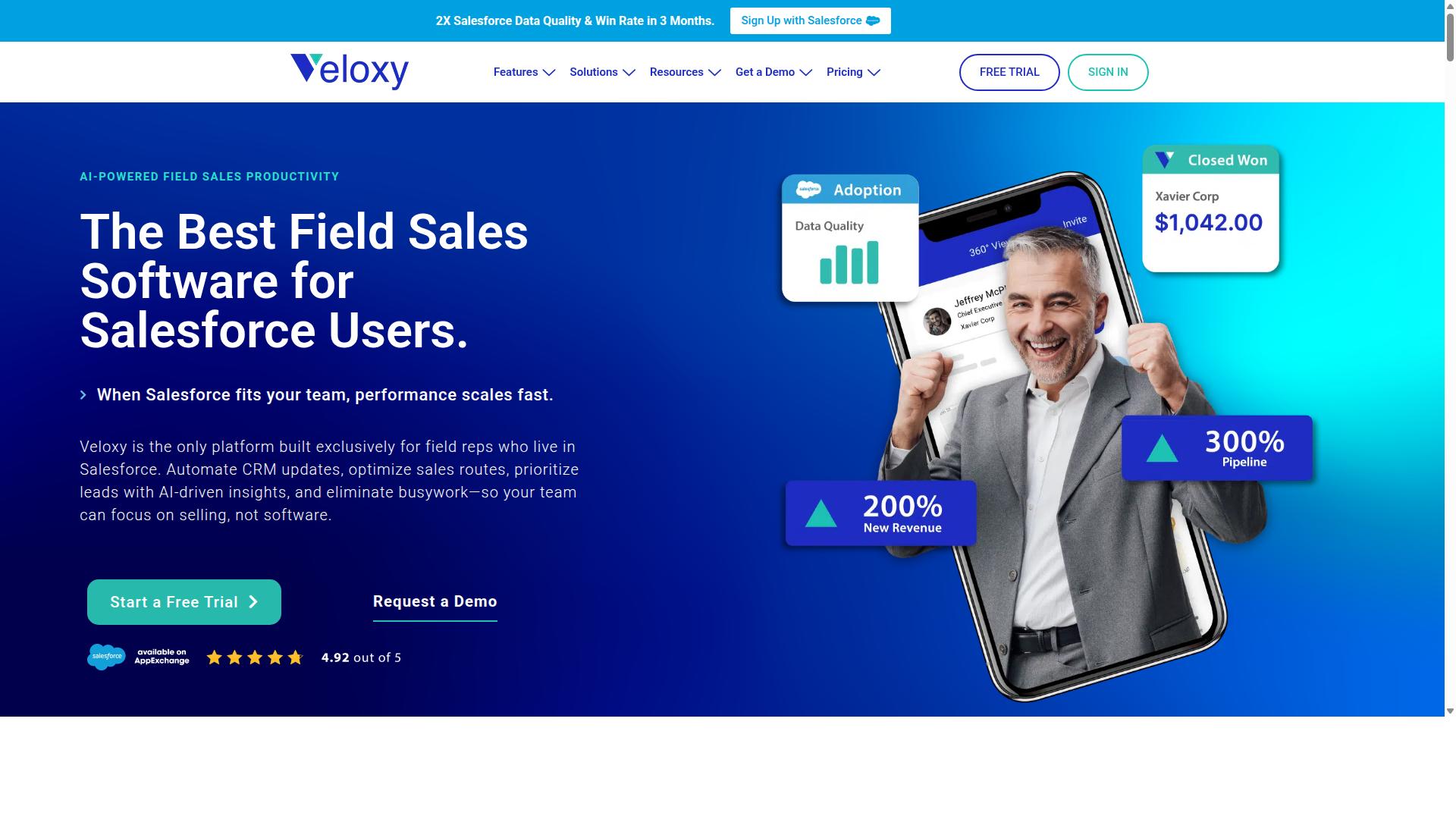
Veloxy is an AI-powered sales enablement and predictive forecasting software built exclusively for Salesforce CRM users, designed to boost field sales rep productivity. Created by VeloxyIO Inc., the platform exists to help sales reps engage directly within Salesforce, so they get more value from their CRM than the effort they put into it.
The core mission is simple: make Salesforce work harder for the people in the field. Veloxy feeds reps the right data at the right time based on their context, location, and upcoming events. Instead of hunting for customer details, the rep sees what matters for the next meeting, call, or follow-up automatically.
Automation is a central pillar of the platform. Veloxy automatically logs actions like calls, emails sent, opens, and replies. This removes the manual data entry burden that slows down field teams and keeps the CRM accurate without extra effort.
For sales management, Veloxy Analytics delivers more accurate forecasts based on historical analysis of biases. Managers also get analytics tools to examine how different sales activities correlate to pipeline growth, revealing which behaviors most directly impact sales outcomes.
The target audience is clear: field and inside sales teams already using Salesforce. If your organization runs on Salesforce and your reps work on the move, Veloxy is built to fit that workflow. It turns Salesforce from a system reps tolerate into a tool that actively supports their daily priorities.
What Is Skynamo?
Skynamo is a standalone field sales management app designed for businesses that want to streamline visit planning, order taking, and team communication without a heavy CRM integration. It operates independently of major CRM platforms, which means it brings its own data structure to the table rather than layering on top of an existing system like Salesforce or HubSpot.
At its core, Skynamo focuses on the daily realities of field teams. Visit planning and route organization sit at the heart of the platform, helping sales reps figure out which accounts to see and in what order. The app also supports order management, so reps can capture purchases on the spot instead of waiting until they return to the office.
Team collaboration is another pillar of the platform. Managers can see what their reps are doing in real time, and reps can share notes or updates about specific customer interactions. This creates a shared operational picture, though it is confined to the Skynamo ecosystem rather than syncing into a broader CRM environment.
For businesses already invested in a major CRM, this standalone approach can feel limiting. Skynamo essentially asks teams to maintain a second system for field activity, which can create data silos. Offline functionality is part of the offering, but the depth of that offline mode and how it handles complex data sync varies depending on your plan and configuration.
Skynamo is best suited for organizations that want a dedicated field sales tool without the overhead of a full CRM implementation. If your team lives in spreadsheets or lightweight tools and needs structure around visits and orders, it offers a clear path forward. However, teams that rely on a central CRM for lead management, opportunity tracking, and customer 360 views may find the separation more of a hurdle than a help.
Features Compared
This section dives into the feature sets of both tools, focusing on the elements that matter most to field sales teams: offline functionality, integration depth, and productivity tools.
Field sales reps work in unpredictable environments. They move between client sites, warehouses, and parking lots, often with unreliable connectivity. The right mobile sales app must keep working when the network drops, then sync cleanly when service returns.
We evaluate each tool on three practical criteria: how well it handles offline data capture, how deeply it connects to your CRM, and how much time it saves reps during a typical workday. These factors determine whether a tool becomes a daily driver or a source of frustration.
Offline Data Sync & Salesforce Integration Depth
In terms of offline data sync and integration depth, Veloxy offers seamless two-way sync with Salesforce, while Skynamo provides standalone offline capabilities that require manual data transfer.
Veloxy is built natively for Salesforce users. Data captured in the field syncs directly to Salesforce, maintaining a single source of truth across your entire organization. This means no duplicate entries, no reconciliation work, and no guessing about which version of a record is current.
Skynamo offers offline data capture, but its relationship with your CRM is less automatic. Reps may need separate handling to move field data into Salesforce, which adds administrative overhead and increases the risk of errors or missed updates.
Veloxy's real-time sync and cloud sync features keep records current as soon as connectivity returns. The platform includes Salesforce automation and pipeline management tools, so reps can update opportunities and track deals without leaving their workflow.
For teams that live in Salesforce, this integration depth is the difference between a tool that complements your system and one that competes with it. Veloxy extends your existing CRM rather than creating a parallel data silo.
Field Rep Productivity Tools & AI Assistance
Veloxy leverages AI to automate routine tasks and provide intelligent recommendations, while Skynamo focuses on structured visit planning and order management.
Veloxy positions itself as the #1 field sales software for reps and managers using Salesforce, and its AI capabilities are a core reason. The Sales AI assistant handles lead qualification, guided selling, and predictive forecasting, reducing the time reps spend on administrative work.
Veloxy users spend 90 to 95% of their time on activities that produce sales. Before Veloxy, that number was only 30 to 35%. That productivity gain comes from automating the busywork that typically eats a field rep's day.
Skynamo provides useful operational tools including route planning, visit scheduling, and order management. These features help reps organize their days and capture transactions, but they lack the AI-driven insights that Veloxy brings to the table.
Veloxy's feature set includes a Quick Dialer, Salesforce Caller ID, and 360 degrees views of customer data. Task lists adapt to the day, and automated workflows handle follow-up steps without manual intervention. The platform also includes buying signals and an opportunity map to help reps prioritize where to focus their energy.
The practical difference is measurable. A rep using Skynamo gets a well-structured day. A rep using Veloxy gets a day that adapts to changing conditions, with AI pointing them toward the next best action based on live data.
Pricing Compared
Pricing for Veloxy starts at $65 per user per month, with discounts for annual and multi-year commitments, while Skynamo's pricing is not publicly disclosed and varies by plan. This makes it difficult to compare the two options side by side without requesting a custom quote from Skynamo.
Veloxy offers transparent, predictable pricing that you can evaluate immediately. A full-featured field sales app costs only $2 per day per user, which makes budgeting straightforward for growing sales teams.
- Monthly plan: $65 per user per month
- Annual subscription: Save 25%
- 3-year commitment: Save 50%
- Company plan: $899 per month for 25 team members
- Annual company plan: Save 45%
- Veloxy Lite: Free trial available
Every paid plan includes a 14-day free trial, so you can test the offline functionality before committing. There is also a performance guarantee: if you don't get ROI in 3 months, you get 3 months free.
Skynamo's quote-based model means you must contact sales to learn the actual price. This adds friction to the evaluation process and makes it harder to compare value across tools.
For field sales teams, the math is simple. Research suggests that field sales reps pay off their annual Veloxy license in 1 to 2 months through improved productivity and streamlined offline workflows. That kind of return is harder to calculate when the competitor's pricing remains hidden behind a sales call.
Who Should Choose Veloxy
Veloxy is the ideal choice for sales teams that are already using Salesforce and want to extend its capabilities to the field with powerful AI and offline functionality. If your organization has invested in Salesforce as its system of record, Veloxy layers directly onto that foundation rather than asking you to switch platforms. This makes it a natural fit for field sales reps and sales managers who live inside Salesforce every day.
The platform is built for field sales, inside sales, and sales management roles. That means it serves both the rep in the field logging visits and the manager tracking pipeline health from the office. Veloxy is designed for sales reps and managers using Salesforce CRM, so the data flows back into the tools your team already trusts.
Teams that benefit most are typically the highest-performing field sales organizations. These are groups where reps cover significant territory, see multiple accounts per day, and cannot afford to lose momentum when connectivity drops. For those teams, offline functionality is not a convenience, it is a core requirement for maintaining sales rep productivity.
Veloxy suits any sized field sales team, from a handful of reps to a large distributed organization. Smaller teams gain structure and visibility without heavy administration. Larger teams gain consistency and adoption across multiple territories.
If your priorities include deep Salesforce integration, AI assistance, and predictive forecasting, Veloxy aligns with those goals directly. The AI assistant helps reps stay focused on the right next action, while predictive forecasting gives managers a clearer view of what is coming. For teams looking to boost Salesforce adoption, Veloxy puts the CRM into the field workflow naturally rather than forcing reps to log data after the fact.
Choose Veloxy when you want your offline CRM to feel like an extension of Salesforce, not a separate tool. Choose it when your reps need real-time data and cloud sync the moment they regain connectivity. And choose it when you want a mobile sales app that supports the entire sales cycle, from lead management and opportunity tracking to customer history and follow-up reminders, all without breaking the Salesforce workflow your team already knows.
Who Should Choose Skynamo
Skynamo is the better fit for businesses that do not use Salesforce and need a straightforward field sales app for visit planning and order management. This makes it an appealing option for small to mid-sized teams that want a dedicated mobile sales app without the complexity of a full CRM ecosystem.
If your team relies on route planning and visit scheduling as the core of daily activity, Skynamo offers a focused approach. Reps who spend most of their day driving between customer locations can benefit from tools designed around the physical rhythm of field work, rather than a general-purpose sales platform.
This solution tends to work well for organizations that prioritize order capture and basic customer history over deep pipeline management. Teams that need to record what was sold, when it was sold, and what happens next can often get by with a simpler system that keeps the sales process moving without extra layers.
The ideal Skynamo user is a growing sales team that wants clarity on daily visits and orders, not a large enterprise with complex reporting needs. If your business is comfortable managing its own sales data and does not need tight integration with a major CRM platform, Skynamo provides a practical starting point that is easy for reps to adopt.
Final Verdict
If your team lives in Salesforce, Veloxy is the superior choice for offline field sales workflows, offering unmatched integration and AI-driven productivity. The deep Salesforce-native design means your reps get a mobile sales app that feels like an extension of their daily CRM routine, not a separate tool to manage.
For teams already committed to Salesforce, the choice is clear. Veloxy brings AI assistant capabilities, sales automation, and offline data capture into one platform that syncs seamlessly with your existing pipeline. Skynamo remains a solid alternative for non-Salesforce users, but it cannot match the depth of integration Veloxy offers within the Salesforce ecosystem.
When weighing offline functionality, data sync, and sales rep productivity, Veloxy consistently addresses the core pain points of field sales. The platform is built to keep your customer history, opportunity tracking, and task management accessible even without a connection, then syncs everything when you are back online. This approach eliminates the friction that kills momentum during client visits.
Veloxy has demonstrated proven results in the field, including reports of doubling sales productivity for teams that adopt the platform. That level of impact comes from combining GPS tracking, geofencing, and check-in features with intelligent route planning and follow-up reminders that keep reps on task throughout the day.
If you are ready to see the difference for yourself, take advantage of the free trial and test Veloxy with your own Salesforce data. You will quickly see how the AI assistant, email integration, and calendar sync work together to streamline your offline workflows.
For questions or to get started, reach out to the Veloxy team directly. You can call (510) 402-6913 or email [email protected] and [email protected]. The team is based at 8031 Oak Creek Drive, Pleasanton, CA, 94588, and you can also connect through Facebook, Twitter, LinkedIn, and YouTube for updates and resources.
Recommended Resources: