
Compliance teams spend hours each week copying evidence between tools to satisfy auditors. Many platforms force manual exports and separate sign-offs, so spreadsheet gaps and missed deadlines appear without warning. This article compares three workflow automation tools and shows which one delivers audit-ready proof without the usual copy-paste cycle.
By the final section you will know the three concrete capabilities that separate Process Street from Vanta and Scrut, the pricing tiers each vendor offers, and a simple checklist for selecting the tool that matches your current audit scope and team size.
What to Look For in Workflow Automation Tools for Compliance Automation
Evaluate workflow automation tools against a checklist of technical capabilities that directly affect compliance outcomes.
Start by examining audit-trail granularity. The system should record field-level changes and individual click actions. This level of detail supports thorough investigations and provides evidence during external reviews.
Next, verify native connectors to major regulatory frameworks. Look for built-in integrations with ISO 9001, SOC 2, SOX, and FDA systems. Direct connections reduce manual data transfers and limit errors during evidence collection.
Automated control testing intervals automate recurring checks without human input. This keeps compliance activities on schedule and reduces the risk of missed deadlines or overlooked requirements.
Role-based access logs should export easily to CSV format and connect to SIEM platforms. This capability supports both internal audits and external security monitoring needs.
Real-time compliance score calculation provides instant visibility into current status. Teams can track progress across multiple regulatory requirements without waiting for periodic reports.
SLA alerts notify stakeholders when tasks exceed policy thresholds. These notifications help maintain consistent adherence to internal timelines and regulatory deadlines.
| Attribute | Manual Process | Workflow Automation | Time Savings |
|---|---|---|---|
| Audit trail granularity | Paper logs or spreadsheets updated manually | Automatic field and click recording | Significant reduction in logging time |
| Native regulatory connectors | Manual data export and import | Direct system integration | Elimination of transfer steps |
| Control testing intervals | Calendar-driven manual checks | Automated recurring tests | Removal of scheduling overhead |
| Access log exports | Manual report generation | One-click CSV and SIEM export | Faster audit preparation |
| Compliance scoring | Periodic manual calculation | Real-time automatic scoring | Instant status visibility |
| SLA monitoring | Manual deadline tracking | Automated threshold alerts | Reduced oversight requirements |
1. Process Street - Best Overall
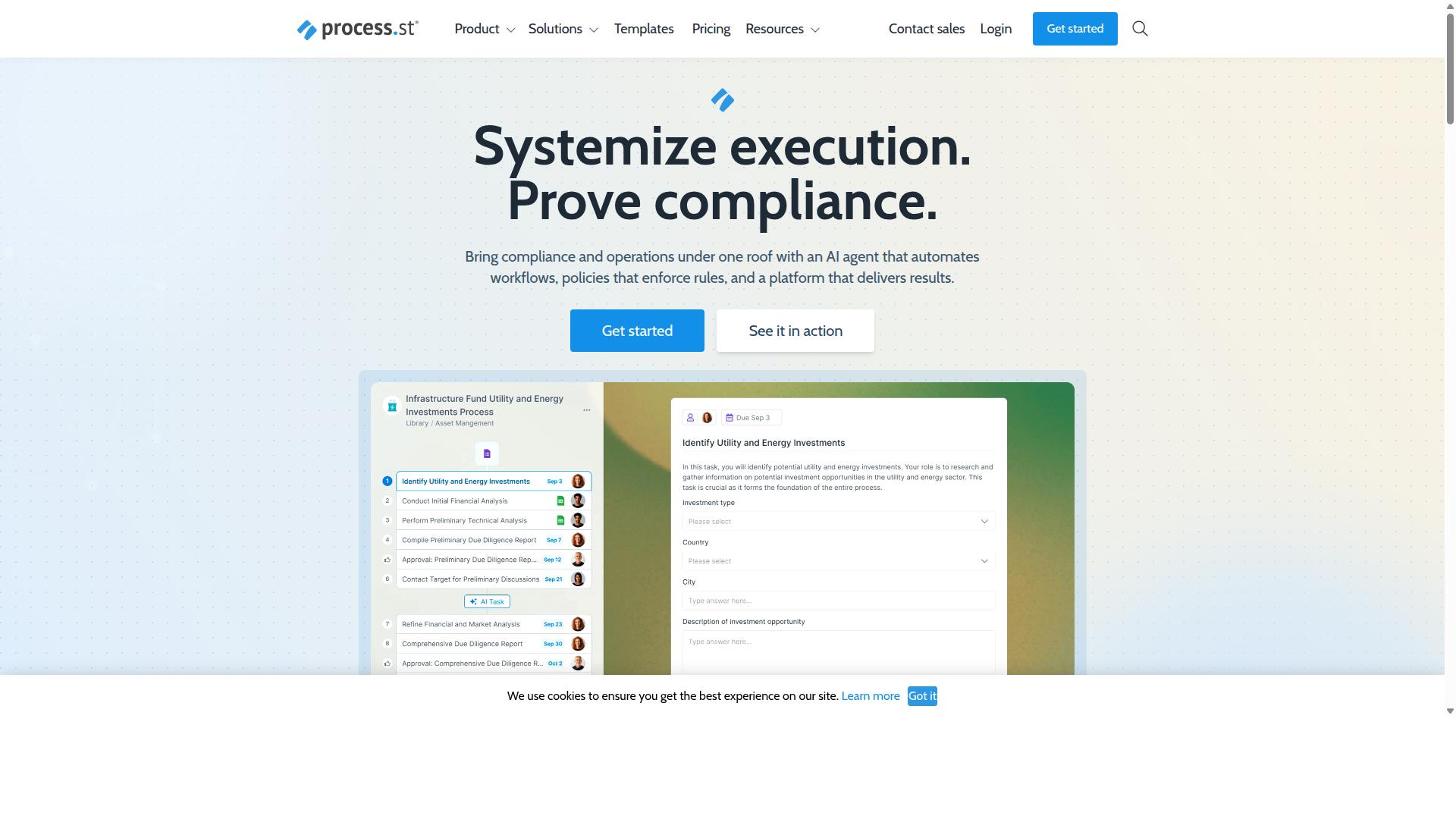
Process Street delivers an integrated compliance operations platform trusted by more than 3,000 organizations.
The platform helps teams standardize processes and prove compliance across multiple regulatory frameworks.
Its three main products work together to automate business processes and enforce policies.
Key Features for Compliance Teams
Process Street provides a single source of truth for policies, procedures, and supporting evidence.
Version-controlled policy documents link directly to assigned tasks so teams always work from current requirements.
The system captures evidence automatically for ISO 9001, SOC 2, SOX, and FDA audits without manual file collection.
A compliance dashboard displays open tasks, overdue items, and an audit readiness score in one view.
Ops Platform for Workflow Automation
Ops turns static policies into AI-powered, trackable workflows.
Each policy step converts into an assigned task with deadlines, conditional logic, and data validation rules.
Automated reminders notify team members when tasks approach their due dates.
IMCD UK reported a 75 percent reduction in setup time after implementing these workflow features.
Cora AI Compliance Agent
Cora AI continuously scans workflows for compliance deviations and surfaces corrective actions.
The agent automatically flags missing approvals before they create audit gaps.
When regulations change, Cora suggests updated control language to maintain policy alignment.
Teams receive compliance score trends over 30-day windows to track progress and identify risk patterns.
Pricing and Plans
Three plans are available, each scaling the number of users, automation actions, and dataset records.
The Startup tier provides access for up to 5 users with 100 automation actions per month. This plan includes unlimited workflows and tasks, 5,000 Data Set records, and a 14-day free trial on the Pro plan without requiring a credit card.
The Pro tier expands capacity to 20 users and 2,000 automation actions monthly. Teams receive access to 10,000 Data Set records, custom user management, and all automation apps with flexible automation action limits.
Enterprise customers gain unlimited users and 10,000 automation actions per month. This tier includes custom Data Set records, unlimited Public API access, a dedicated Success Manager, and priority support for complex compliance automation needs.
Annual billing provides discounts across all tiers. Enterprise customers also receive fully-managed workflows, custom integrations, bulk document import, process consulting, health audits, and personalized team training for regulatory compliance requirements.
2. Vanta
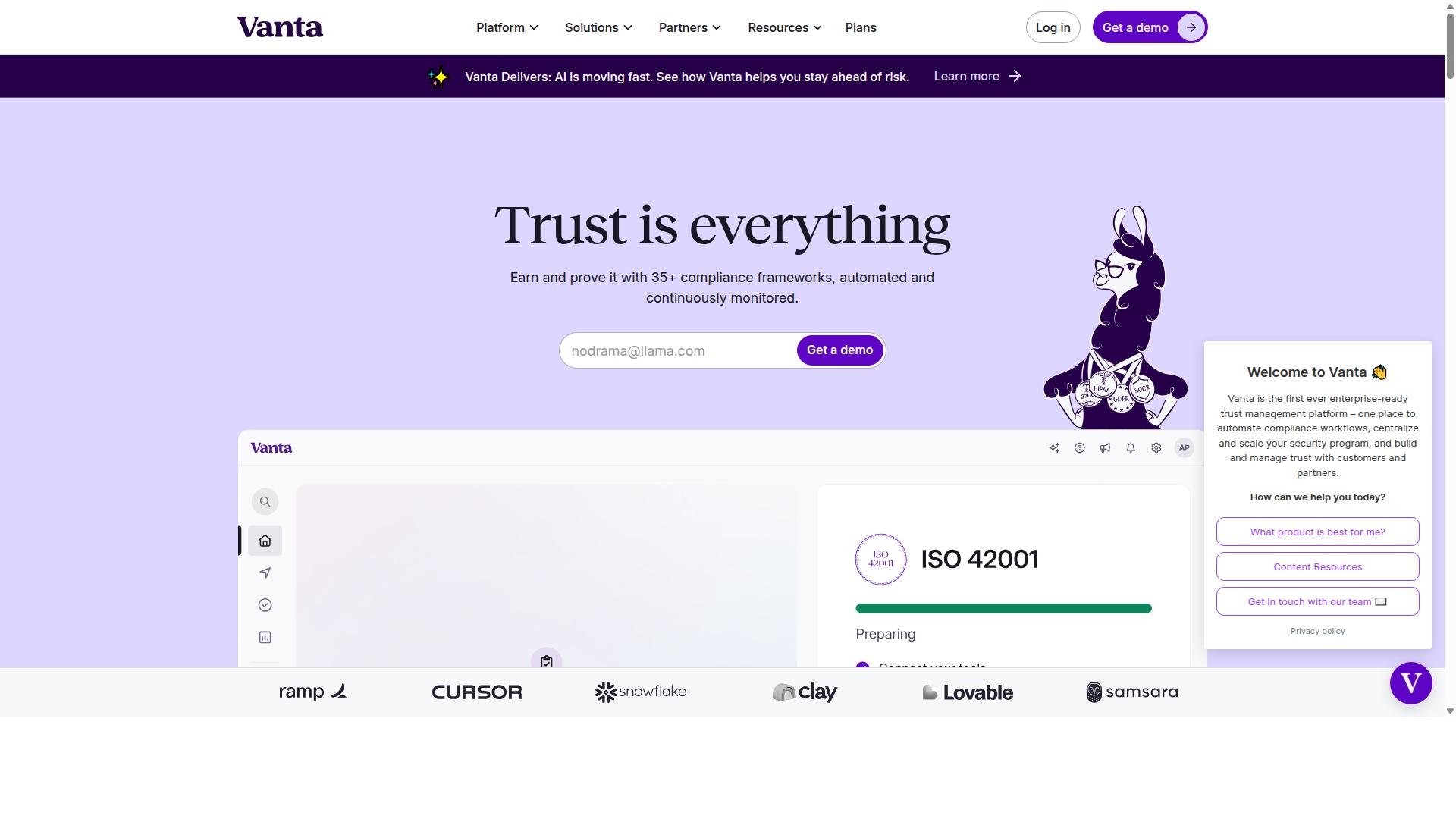
Vanta automates evidence collection for popular compliance frameworks. Organizations use it to maintain security standards across multiple regulatory requirements at once. The platform focuses on continuous monitoring rather than point-in-time assessments.
Companies select Vanta when they need ongoing visibility into their security posture. The tool reduces manual work by connecting directly to cloud services and pulling relevant data automatically. Teams gain time to address actual security issues instead of chasing documentation.
Core Capabilities
Vanta continuously monitors cloud resources and maps controls to SOC 2, ISO 27001, and HIPAA. The system gathers evidence from connected platforms without requiring manual uploads or spreadsheets. Organizations receive alerts when controls fall out of compliance.
Automated evidence gathering pulls relevant files and logs from integrated systems on a regular schedule. Risk assessment dashboards display current status across all monitored frameworks in one view. Teams can see which areas need attention without running separate reports for each standard.
Integration with common cloud providers allows the platform to check configurations and access permissions directly. The system tracks changes over time and maintains records for audit purposes. This approach supports both initial certification efforts and ongoing compliance maintenance.
Target Use Cases
Teams adopt Vanta to maintain continuous compliance in fast-changing tech environments. Startups preparing for their first SOC 2 audit find the automated approach reduces preparation time. The platform handles evidence collection while teams focus on implementing required controls.
Scaling SaaS companies managing multiple frameworks benefit from unified dashboards. Instead of tracking separate requirements for each standard, teams see all controls in one system. This consolidation helps prevent gaps when adding new compliance obligations.
Security teams needing real-time visibility use the monitoring features to catch issues early. The platform sends notifications when configurations drift or new risks appear. This proactive approach supports both audit preparation and day-to-day security operations.
3. Scrut Automation
Scrut Automation focuses on unified control management across IT and security teams.
The platform helps organizations maintain oversight of regulatory requirements through centralized tracking and monitoring capabilities. Security teams can coordinate their compliance efforts without switching between multiple disconnected systems.
Compliance automation becomes more manageable when evidence collection and control monitoring happen within a single environment. This approach reduces the manual effort typically required to maintain regulatory compliance across different frameworks.
Core Capabilities
Scrut aggregates policy status and control effectiveness into a centralized console.
The platform supports policy mapping that connects organizational rules to specific regulatory requirements. Teams can track how individual policies align with different compliance standards through structured documentation.
Vendor risk scores provide visibility into third-party security posture and potential compliance gaps. Organizations receive scheduled compliance reports that summarize current status across multiple regulatory frameworks.
Control monitoring features help teams identify when security measures fall outside expected parameters. Continuous assessment reduces the likelihood of discovering issues during formal audit periods.
Target Use Cases
Mid-market organizations use Scrut to streamline GRC processes across multiple regulations.
GDPR evidence packs help teams prepare documentation needed for data protection assessments. The platform organizes required materials and tracks completion status for privacy-related requirements.
ISO 27001 surveillance audits benefit from structured evidence collection and control documentation. Teams can maintain the continuous monitoring needed between formal certification reviews.
Quarterly board-level compliance reports provide executives with visibility into regulatory status across the organization. These summaries help leadership understand progress toward compliance objectives without requiring technical detail.
How to Choose the Right Option
Map your team's compliance scope, required integrations, and growth trajectory to the platform that best aligns with those parameters.
Teams that handle multiple regulatory frameworks need tools built for scale. Start by identifying how many compliance standards you manage at once.
Next, estimate your monthly audit evidence volume so the chosen platform can handle the load without manual intervention.
Some teams benefit from AI-assisted remediation while others prefer full manual oversight. Clarify this preference before evaluating options.
Existing tech stack compatibility matters because seamless connections reduce setup time and lower error rates across systems.
Finally, define your budget range per user so each platform comparison stays grounded in realistic costs.
| Criterion | Score 1 | Score 2 | Score 3 |
|---|---|---|---|
| Number of frameworks managed simultaneously | 1 framework | 2-3 frameworks | 4+ frameworks |
| Volume of monthly audit evidence items | Under 100 items | 100-500 items | Over 500 items |
| Need for AI-assisted remediation | No AI needed | Limited AI features | Full AI automation |
| Existing tech stack compatibility | Minimal integrations | Standard connectors | Enterprise integrations |
| Budget range per user | Under $20/month | $20-50/month | Over $50/month |
Teams in financial services, healthcare, and manufacturing often score higher across multiple criteria. Process Street supports organizations across these industries with use cases including ISO compliance, document control, and employee onboarding.
Assign scores across the five criteria and rank platforms by total points. The highest-scoring option becomes your shortlist for deeper evaluation.
Final Verdict
The platform that demonstrates measurable reductions in audit prep time and verifiable proof of control effectiveness earns the top position. Process Street delivers documented results backed by third party certifications and user outcomes.
Organizations report 30% faster documentation when replacing manual compliance processes. This gain compounds across repeated audit cycles and regulatory reporting periods, freeing teams from repetitive document assembly tasks.
Process Street also supports standardized onboarding for 49k+ employees across its customer base. Consistent process execution helps companies maintain control effectiveness as headcount grows, a critical factor for regulatory compliance and audit management.
SOC 2 Type II and ISO 27001 certifications provide external confirmation of internal controls. These attestations matter when auditors review data governance and security practices for compliance automation platforms.
Companies selecting workflow automation tools should examine published case studies and certification status. Process Street supplies both, giving compliance teams concrete evidence rather than marketing claims alone.
Recommended Resources: